What synchronization tests are and how they are performed using VIAVI MTS-5800 testers
Eng. Emiliano Alaimo Tecnous SAThe synchronization tests we propose allow you to verify the status of this critical function across interfaces ranging from 1PPS to 25/100 Gbps, PDH, Ethernet, IEEE 1588-2008 (PTP), and SyncE. To do this, the tester must have an internally ultra-stable reference module (rubidium-stabilized oscillator) that will provide, in portable form, the precision needed to achieve the respective metrics according to the acceptance thresholds specified by ITU-T. It also enables validation of GNSS accessibility, delivery of stable 1PPS / 10MHz auxiliary signals to OTHER measurement devices, among other conveniences.
A review of synchronization measurement concepts, techniques, and measurement proposals…
- What do we physically measure? … we measure time error or TE ("Time Error")
- How do we measure it?...by means of a "PTP Telecom TimeSlave Clock" (T-TSC) with portable and autonomous characteristics (battery-operated and capable of operating in "Holdover"), which is embedded in the BER tester.
- Where do we measure? … equipped with this equipment, we traverse the synchronization chain, and evaluate compliance with what is called the Time Budget, both in terms of total compliance and partial compliance at each hop. We cover everything from a given "Telecom Grand Master" (T-GM) to a given slave on the network edge, associated with that master.
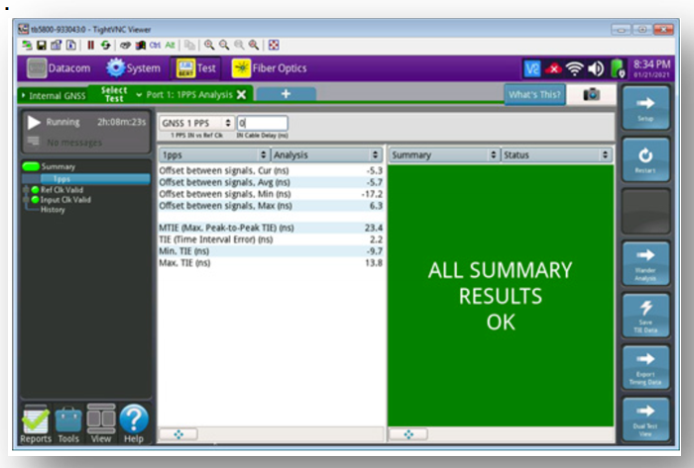
- How is each measurement processed? ... we collect "Time Interval Error" (TIE) measurements which are instantaneous measurements evenly distributed over a given time window. From this set of measurements, the tester post-processes and obtains the following metrics: – "Maximum time errors" (Max |TE|) – "Constant time error" (cTE) – "Dynamic time errors" (dTE) – "Maximum Time Interval Error" (MTIE) – "Time Deviation" (TDEV)
It is important to note that these procedures are firmly defined by ITU-T regulations, from which compliance curves are available that allow the tester to obtain pass/fail criteria for each metric. These criteria in turn vary in values according to each combination of interface and synchronization technology. In each case there is a defined synchronization compliance requirement that needs to be measured. The tester performs the correct measurements for the test case configured by the user.
Example of a synchronization chain:

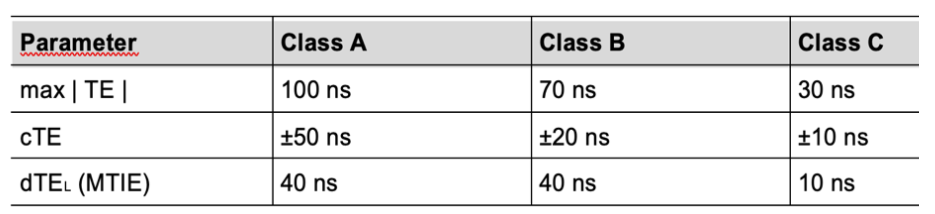
Examples of time budgets:
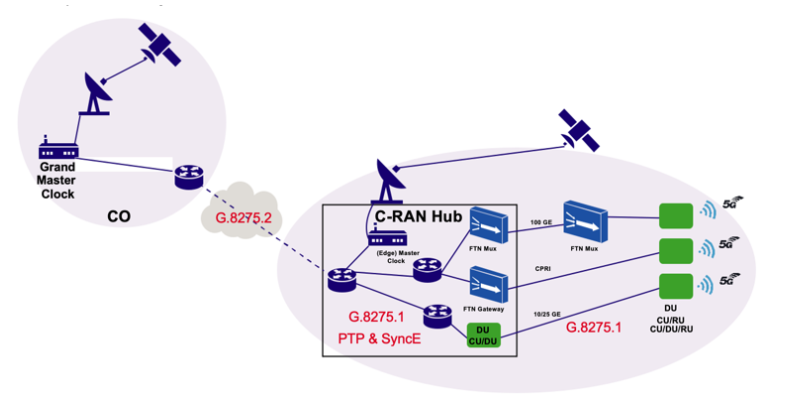
4G + 5G Architecture where this measurement is critical:
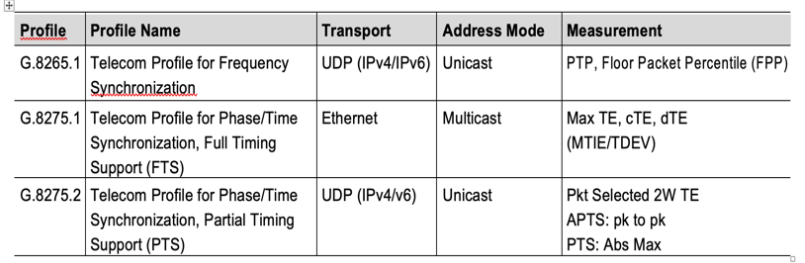
Relevant standards and associated measurements:
Benefits
- Validate proper delivery of synchronization services in LTE Advanced and 5G deployments
- Do so in a simple and systematic manner through test flows designed for implementation by installation technicians and TIER1 personnel.
- Have extremely precise measurements that demonstrate compliance with ITU-T standards
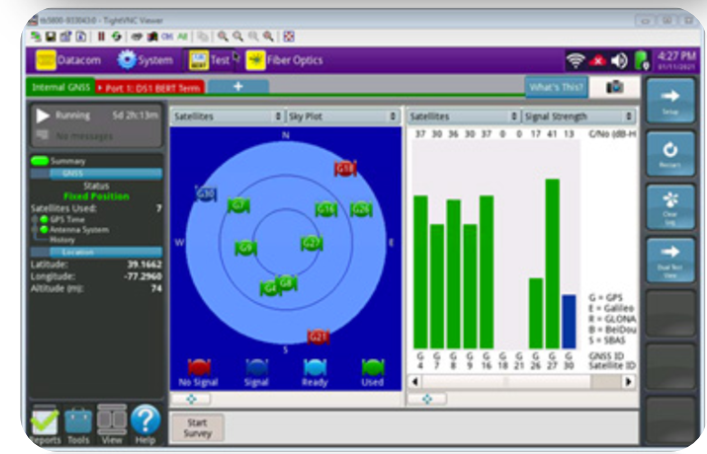
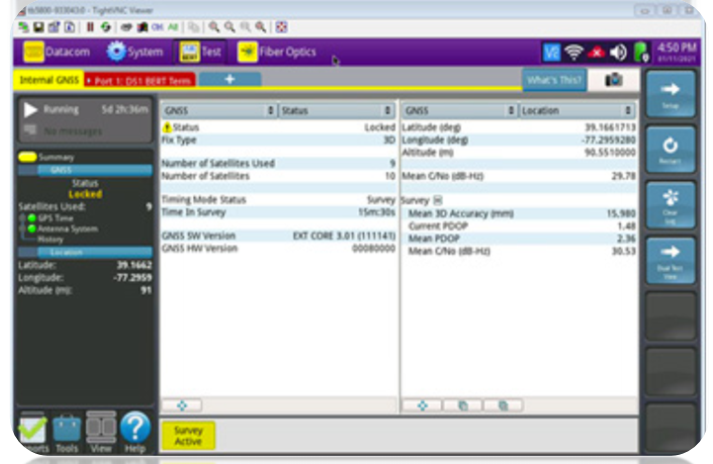
- Additionally provide technicians with a tool that verifies critical functional aspects at the time of installation. For example, the ability to measure satellite availability for any "GNSS" navigation system cloud. Precisely define the location (coordinates and altitude) of the tester, accurately determine absolute phase and UTC time, and thus verify master compliance on-site.
- Have pre-built traffic testing capabilities in the BERT, such as PTP traffic capture and troubleshooting tools useful to engineers for debugging implementation issues or determining complex faults
MTIE measurements and GNSS availability